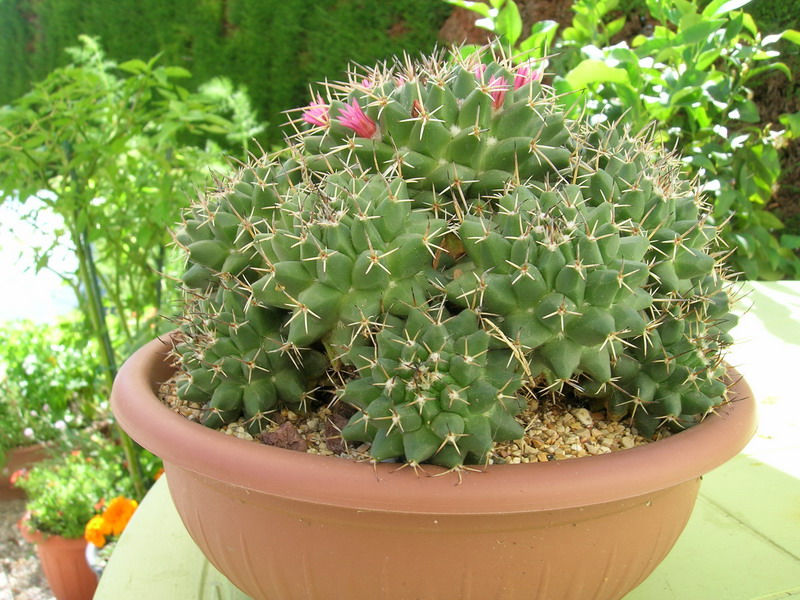
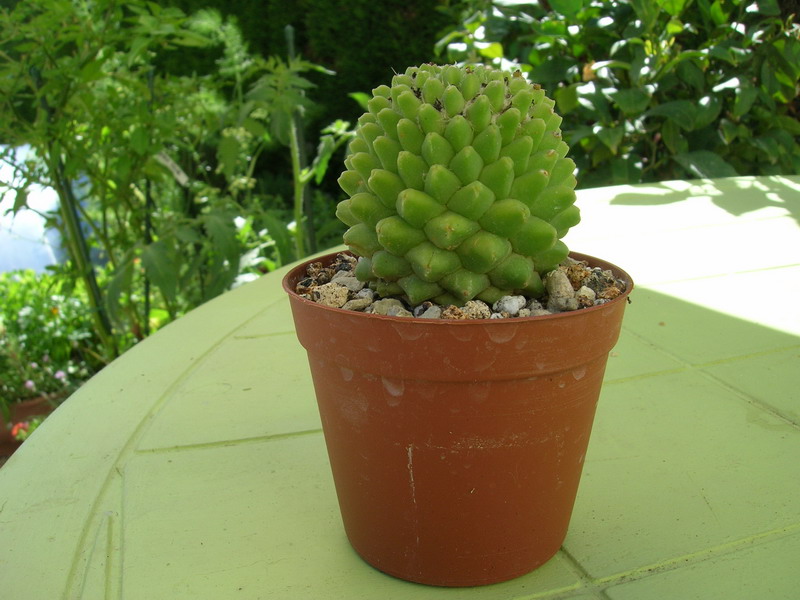
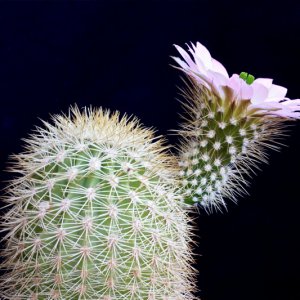
Direi che la prima potrebbe essere Mammillaria compressa (mother of hundred).
Mammillaria angularis descritta da Pfeiffer nel 1837 appare per la prima volta illustrata nel 1907 e macroscopicamente è identica alla precedente.
Siamo a differenze microscopiche
Mammillaria angularis è diploide (la diploidia è la condizione in cui nelle cellule somatiche di un organismo vivente sono presenti due copie per ogni cromosoma), mentre Mammillaria compressa è tetraploide (ogni la possiede quattro serie di cromosomi).
Queste sono note apparse sul Journal of the Mammillaria Society nel Febbraio 1963......
NOTES ON M. COMPRESSA Vs ANGULARIS
by Wolfgang Plein
The recent cytological studies Mr. Hunt reported on in this Journal have raised again the question whether M. compressa and M. angularis really are the same species, for M. angularis has been found to have twice as many chromosomes as M. compressa. It may be interesting, therefore, o ompare other differing details of both species. The description ofe flowers of M. compressa accepted today is, 'Flowers campanulate, 10 to 15 mm long. Outer perianth-segments, wide purplish-brown mid stripe, narrow tannish pink margins, lanceolate, tip acuminate, margins ciliate to finely serrate. Inner perianth segments, deep purplishpink narrow mid-stripe, rose-red margins, linear-oblong, tip acute to acuminate, margins entire. Filaments, very pale pink. Anthers, pale greenish-yellow. Style tan. Stigma-lobes, 4-6, pale pinkish-tan, linear.'
(Craig, Mammillaria Handbook, p.19, 1945). This description is cited by Backeberg, too. (Backeberg, Die Cactaceae, Vol.5,p.3,118-1961). Berger, (Kakteen, p.326, 1929) gives a slightly varying description, 'Flowers 10-15 mm long. Outer perianth-segments, somewhat fringed. Inner perianthsegments, bright rose-red with darker middle. Filaments and style, pale red. Stigma lobes, 5-6, white'. Tracing a still older source, in Schumann we find under the name of M. angularis to which M. compressa is referred as a synonym, the very short description, 'Flowers very rare, rose-red, similar to that one of M. centricirrha Lem.' (Schumann, Gesamtbeshreibung
d. Kakt. 576.1899).
Dietrich however, very particularly describes the flower of M. angularis
var. triacantha SD which is referred to M. angularis resp. M. compressa as a synonym, 'The flowers are carmine-red, a little spread, ½" diameter.
Filaments, golden-yellow with dark golden-yellow anthers. Style yellowishgreen, with 5 orange stigma-lobes'. (Dietrich, Allg. Gartenz. XVI.299. 1848). Thus, Schumann already did not know this description any more. As it distinctly differs from the description of the flowers of M. compressa given by Craig, the question suggests itself if these specie
L'ultima modifica di maurillio il Mer 07 Giu 2017, 19:34, modificato 4 volte |
 FAQ
FAQ Gruppi
 Registrati

 Messaggi privati
 Cerca
Cerca Entra
Entra